Showing posts with label unions. Show all posts

Thursday, April 21, 2011

Dr. Antonio Calvo's Tragedy: Could It Have Been Avoided?

What happened to Dr. Calvo who killed himself after being fired in a really nasty way by Princeton University is truly tragic. The question that, of necessity, is on everybody's mind is what can be done to prevent such tragedies from happening in the future. At-will firing that is the norm in the US is a horrible, inhumane practice. People can be told to clear their work spaces and leave without any warning whatsoever. Often, they are escorted from the premises by security guards and prevented even from saying good-bye to their colleagues of many years. In academia, getting fired between the months of April and September also means that you will not be able to go on the job market until it reopens on September 15. Furthermore, you will not be able to start working until September of the year after that. People who are not US citizens face almost immediate deportation after their work visas are revoked. Obviously, this system implies a lot of pain and suffering for the employees. Workers have to live in a constant fear of dismissal which takes a huge emotional toll.

Unions seem to offer a solution to this issue. They will protect employees from getting kicked out with no warning. However, unions have their problems, too. As important as it is to protect the rights of the employees, it is equally crucial that employers are protected as well. Unions make it extremely hard to dismiss bad employees and reward the good ones. To give an example, the union prevented my department from offering a monetary reward to a stellar instructor on the grounds that every member of the union should be compensated equally. And all my whining about how hard it is to get students to speak Spanish in class? This issue would be easy to solve if it weren't for the union.

It seems like the only productive solution to balancing the needs of both workers and employees is to have a disinterested third party that will impose a system of regulations to protect everybody. That third party has to be the government. Take Canada, for example. I'm not a complete and utter apologist of Canada, in any way or manner. However, it is evident to me that the way Canadians deal with the issue is quite productive. There is a system of regulations in place that outlines how, when and for what reasons an employee can be fired. People are also provided with a financial cushion that transforms the loss of a job from a tragedy into nothing more than an annoying temporary setback.

Contrary to Libertarian beliefs, this did not hamper Canadian job market in any way. Compared to what we see in the US today, the situation with employment in Canada is quite good.

Saturday, March 5, 2011

Professors Don't Care?

I really loved our rally in support of public workers in Wisconsin and everywhere across the country. One thing, however, bothered me and keeps doing so today. Aside from me, there was only one faculty member from our university. We are a public university, and are being constantly threatened with losing our health care benefits. The institution of tenure is being eroded constantly. We had all our funding frozen last year because the state wasn't giving us our money. The situation is very precarious for all of us.

David Ruccio has the following to say about the current state of affairs in higher education:

It looks like public universities that can (like Madison) are becoming more like private universities. Meanwhile, well-endowed private institutions may be the only universities where the idea of the university is being safeguarded. Combined, the two tendencies—the privatization of public universities and the privatization of the idea of the university—represent a bridge to the end of the public university system as we have known it in the United States. That leaves us nowhere.
The last sentence of this comment is literally true for those of us who work for public universities.  If (when) public universities fall apart, we will have nowhere to go. Of course, those of us who have been publishing like crazy this entire time, can expect to be picked up by private schools. The rest, however, will be left behind. Why, then, are professors so unwilling to join the struggle for the rights of employees?

Part of it, I believe, is snobbery. What do we have in common with all those carpenters, steel workers, and teamsters? We are still middle-class while they have been displaced from it. We forget, however, that when these intelligent, politically active workers cannot afford to send their kids to our university any more, we end up with the student body that is impoverished intellectually.

Another reason why professors don't care is their belief that this will not touch them. Even though we keep hearing news about tenured faculty being fired all over the country, many of my colleagues like to pretend that this will never happen to them. I can't tell you how many times I heard senior colleagues say, "Of course, this will not touch me. I'm tenured." Have the SUNY Albany, the U of Southern Mississippi and other places never happened, I always wonder when I hear that?">

Of course, I will be told that I'm exaggerating. People are just too busy, I will be told. I don't buy that, though. If a huge crowd of our faculty members had come to the rally, this would have sent a really important message to our administrators. And that would have benefited us a lot more than any silly committee and any useless meeting.

Wednesday, March 2, 2011

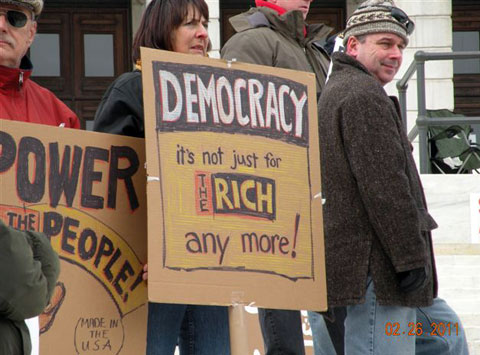
Our Rally in Support of Wisconsin and Public Sector Workers Everywhere

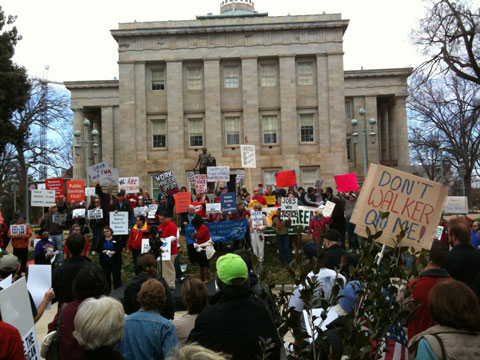
We might be a backwards little town in the middle of nowhere. We might be located in the Bible Belt. We might belong to a very conservative area of the country that keeps voting Republican for no discernible reason. Today, however, we gathered to conduct our own rally in support of the protesters in Wisconsin.
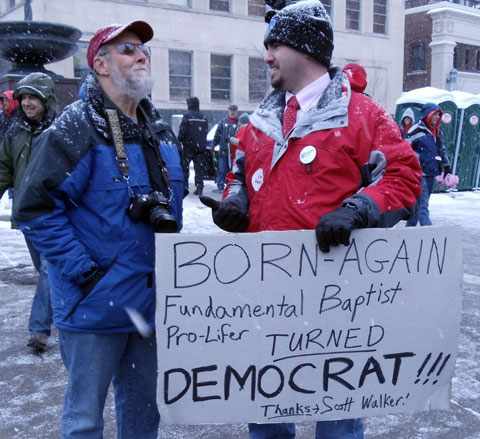
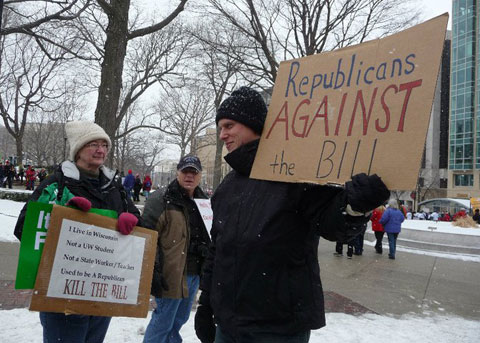
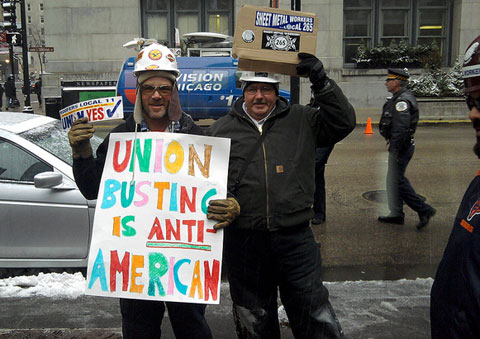
 I started taking pictures before the rally began, so there are not that many people around at this point. A lot more people joined us as the rally began. Altogether, I'd say there were between 250 and 300 people. Obviously, I didn't interrupt the speeches by running around with my cell phones, taking pictures. 
There were steel workers, teamsters, carpenters, teachers, healthcare workers, retirees. Hardworking, modestly dressed people who believe that there is no democracy without the people's right to enter into collective bargaining to improve their work conditions.
 "We are the middle class," said many of the speakers. These are mostly people of my parents' age who have seen their standard of living decline and the hopes of their children and grandchildren diminish. "I want to make sure that my son and grandson have the same rights and benefits that I did as a union member," said a steel worker.
"This is what democracy looks like!" chanted everybody at the end, echoing the rallying slogan of Wisconsin's protesters. "Welcome to the workers' revolution!" a young union organizer exclaimed. Everybody cheered.

Today, I finally felt that I belong in this town.

P.S. Whenever I turn on the television, I see programs dedicated to some Charlie Sheen character who seems to have gotten himself into some excruciatingly boring trouble. Finding reports of protests across the country is not as easy. We need to cover them ourselves, people. Go to your local rallies, tweet, blog, Facebook, do whatever you need to get the word out. 

Tuesday, March 1, 2011

Report the Protests!

Look at these inspiring pictures of protests all over the country. This wave of protests is being severely under reported by the media. Tomorrow we are planning a little rally of our own, and I will post pictures.

In view of the corporate media's attempts to silence the protests, we need to cover them ourselves and spread the news. See more of these inspirational pictures here. And post your own. Or send them to me and I will post them. If nobody will cover real news, we need to do it ourselves.

A Hilarious Comic Strip About the Reactions to Union Protests

I don't know about you, but I love Jen Sorensen's comics. See, for example, this one about the ways in which many people react to the current union protests in Wisconsin:

I found this great strip here.

The Future of Unions

Ezra Klein has written a great column about unions titled "How unions can be more than a legacy institution." He offers an honest look at why unions have been so unpopular in recent decades. We all know that only 7% of private sector workers are unionized today. This number went down dramatically since the 1970ies when over a quarter of all private sector employees were members of a union. 

Today's crisis in Wisconsin, says Klein, has offered a once-in-a-lifetime opportunity for the unions to gain the sympathies of the public and make themselves attractive to larger numbers of the population. In order to do so, unions have to recognize and renounce practices that have caused so much popular resentment against them:
If unions are to not just survive, but to actually flourish again, they need to create an identity beyond being a protection service for people who aren't very good at their jobs.
 As I mentioned before, I used to be a union organizer for the graduate students at my university. Our union achieved many important things. However, there came a time where I couldn't, in good conscience, associate myself with it any longer. The union consistently tailored all of its decisions, policies and strategic goals to the needs of the underachievers. Those who believed they needed 8 to 10 years to complete their doctoral program were supported and celebrated as true scholars while those of us who wanted to graduate as soon as possible could not get our needs taken into consideration by the union. The culmination of this drive towards turning us all into underachievers was a forceful union campaign to abolish grades for graduate courses and the union's passionate conviction that it is unacceptable for professors to fail graduate students at their comprehensive exams. 

For some reason that I still haven't been able to grasp, many unions operate under the assumption that all workers contribute equally and that no employee can be lazy, incompetent and stupid. Any system that is based on this set of beliefs is bound to fail. It will reward the underachievers and punish hard workers. Unions often prevent people who have done a particularly good job to be rewarded. (I have seen this happen at the school where I work right now, so don't tell me it doesn't happen.) As a result, productive people will end up carrying the load of their lazy colleagues while getting no reward for it. How soon, do you think, the quality of everybody's performance will drop? 

Unions should abandon the pernicious idea that nobody is better, more intelligent, more hard-working and more worthy of being rewarded than anybody else. They should remember that their goal is defending the rights of live human beings and not some robots that always act the same and produce work of the same quality. If anything will save the unions, it is the recognition that while people should be equal, they will never be the same.