Showing posts with label research. Show all posts

Tuesday, May 17, 2011

A Helpful Insight From a Fellow Blogger

It is uncanny how helpful reading blogs can be to a person. I've been putting off the moment when I will stop looking for more and more and ever more sources for a new chapter I want to add to my book and will finally start writing. The search for sources took so long that I have now completely forgotten what I read in the sources that I had found at the beginning of this protracted search. When the summer holidays began, I decided to inaugurate them with yet another search for sources. In the meanwhile, I kept congratulating myself on how hard-working and productive I was being.

And then, as I was browsing through some older entries on one of my favorite blogs, I saw a very short post that seemed to be directed at me personally. It said something like this, "Stop reading already. You have read everything you need on your topic. Now just start writing." 

"Hmm," I thought. "This kind of makes sense." So this morning I woke up early and finally started writing. And I already have 491 words in my new chapter. That doesn't sound like a lot, but it's more than I had written during all that time I was searching for sources.

I'm thinking of ordering a poster with this beautiful insight and sticking it in front of my desk. These three short sentences probably encompass the best piece of advice one can give to any academic.

Thursday, April 28, 2011

Words of Wisdom from a Senior Colleague

A senior colleague in a field closely related to mine is about to retire. Here are some excerpts from a personal email I received from this scholar*:
As I look back on my career in academia, the greatest regret I have is that I didn't prioritize my research as much as I could have. I know that I could have done a lot more, made a greater contribution to my field, published more consistently. The world of academia offers so many activities and imposes so many obligations that seem designed to entice us away from our desks, from our unfinished manuscripts, from that eternally terrifying blank page it is our calling and our duty to fill. It is never too hard to find convincing, seemingly valid reasons why this difficult and often painful work needs to be postponed. "Just one moment more, executioner, just one little moment more," we plead in the style of Madame du Barry faced with the guillotine whenever we find ourselves in front of that blank page. This, however, is the greatest mistake made by so many scholars. . . Your are still very young, and your life as a scholar is just beginning. Since you asked for advice, here is the best suggestion I can offer: do everything in your power to make a name for yourself as a specialist in your field. Your record of publications will be the bulwark that will protect you in times of strife and uncertainty, give you security, respect, and ultimately, yes, power. There are institutional humiliations that become harder to accept as you age. . . The only way you can prevent the work of a lifetime from being undermined by these kinds of pressures is by ensuring that your name carries enough weight to shield you.
*Of course, I requested and received permission to publish this text anonymously on my blog. I translated it into English, so all verbal infelicites should be attributed only to me.

Thursday, April 14, 2011

Research and Sprats

When I was a kid, I hated food. All and any kinds of food. The mere smell of food would make me gag. I spent more time dry heaving when I was a child than doing pretty much anything else. You wouldn't guess this if you met me today, but that's how it was. The only kind of food that I loved were these Baltic sprats that you can see on the picture. So whenever I was served a plate of food that included the sprats, I would think to myself, "OK, so I will first force myself to eat all this nasty stuff so that it doesn't cloud my enjoyment of the lovely sprats. When I'm finally done with the food I hate, I will be able to dedicate myself fully to the delightful food that I like."

Of course, after I managed to force down the food that I hated, all I felt like doing was throwing up and couldn't eat the sprats. "This is very strange," my mother would say. "I gave you the sprats because I know you love them but you ate everything else and left them behind."

The reason why I'm telling you this otherwise boring story is that I still have a severe case of sprats when it comes to doing research. To give an example, this week I had some writing planned that I've been dying to do. Thinking about how I would finally sit down and dedicate myself to this truly enjoyable piece of work was the highlight of my week. I simply couldn't wait to get started. Of course, I decided that first I needed to get all the other, boring stuff out of the way so that I would be able to proceed to do my research undisturbed by the unpleasant tasks I needed to perform. So I started on the unpleasant tasks, hating them passionately for keeping me from the enjoyable research. A lot of time was spent on complaining and moaning to everybody in and out of sight about how these nasty tasks were getting in the way of me doing what I really wanted to do. In the meanwhile, more of these little unpleasant assignments kept cropping up. 

When I finally finished the unpleasant assignments and sat down to my writing, I discovered that I was so drained that I could make no sense of what my own text was saying. 

I blame the sprats.

Thursday, March 10, 2011

A Good Day of Research

Tools of my trade

A close encounter with colleagues who do everything they can to avoid doing research, inspired me to accomplish a great deal in my work on my next article.

I'm very thankful to slackers right now.

Sent via BlackBerry by AT&T

Wednesday, March 9, 2011

An Elusive Journal in My Field

I requested a fairly recent article (it was published in 2001) on the subject I'm working on right now through our university's Interlibrary Loan. Our library is pretty sucky but our library services (including ILL) are outstanding. They always deliver everything I request extremely fast. This article, however, they have not been able to locate in any of the collaborating libraries. They say they are "unable to find any libraries owning this journal that participate in Worldcat Resource Sharing."

I wrote to the article's author to see if he'd be willing to send me the text of the article. Its title sounds very interesting, and I don't want to submit my own article without consulting this previous study. Now my question is: does the difficulty in locating this journal mean the journal is not good? I was actually planning to submit my own article there but now I'm wondering whether it makes any sense to publish in a journal that nobody can find or consult later on.

Saturday, March 5, 2011

Research and Order

One thing I am very proud of is the way I organize my research. I am convinced that unless the entire process of doing research is organized according to a consistent and reliable system, too much time will be wasted on rummaging among stacks of papers in search of that one elusive quote. We have all had that feeling of having read something useful on the subject we are researching somewhere in the huge mass of articles and books that we accumulate for each project but having no idea which source in particular contained this useful statement. 

Of course, everybody has their own system of organizing their research. Mine is aimed at helping me to achieve two goals:

a) not to waste any time in search of something that I vaguely remember seeing somewhere;
b) be able to work on my research everywhere. You never know when a couple of hours might free up. It is always such a pity when, say, a meeting is cancelled but you can't use the time to write because your research materials are elsewhere.

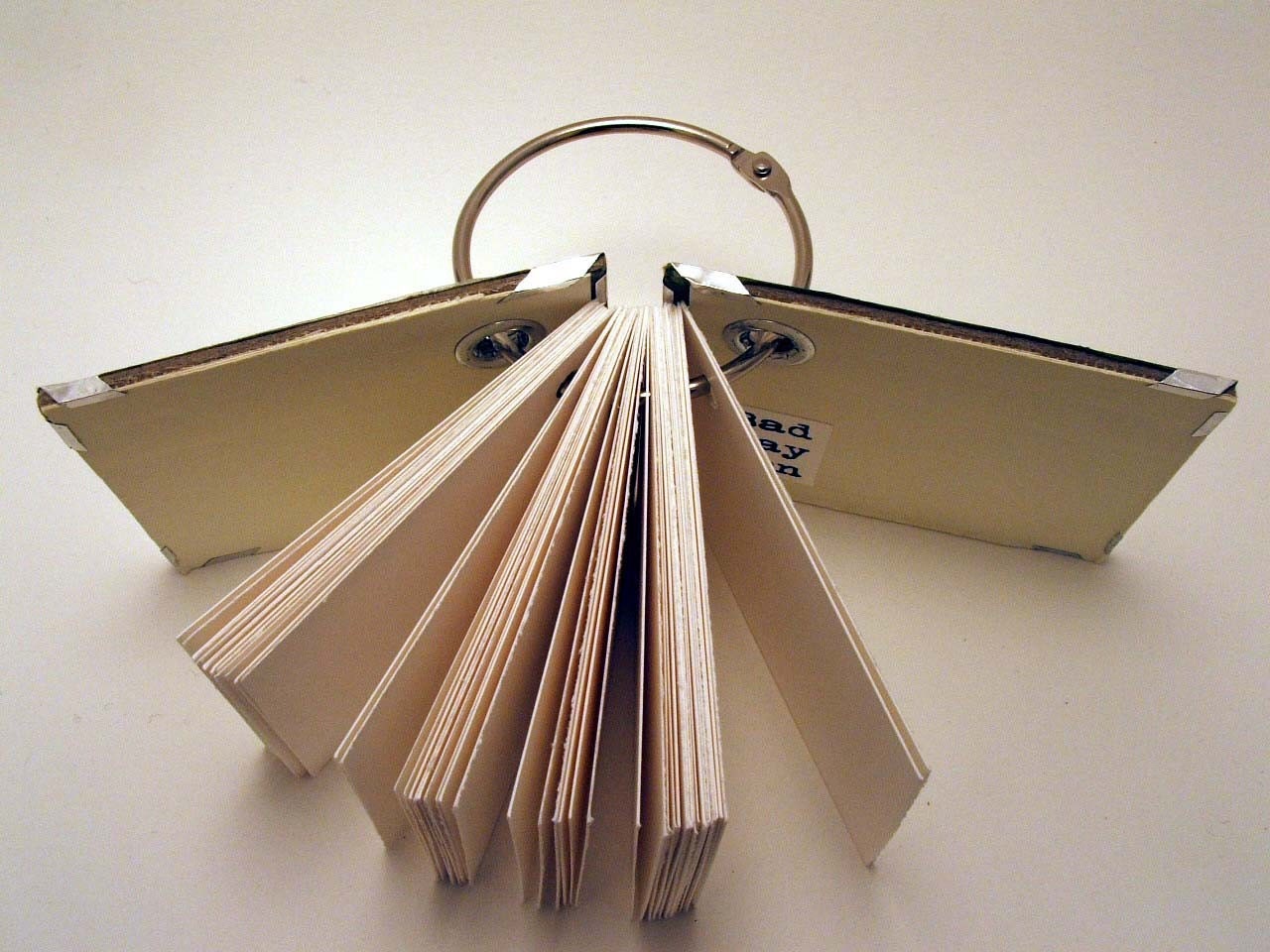
You can buy a fairly small key-chain with cue
cards that will not clutter your
handbag and will even fit into
a pocket
Any research project in my area begins with a lot of reading. First, you read or re-read your primary sources. In my case, the primary sources are often lengthy Realist novels. Then, I think about the reading for a while, write down several ideas, and turn to secondary sources to see what people who have researched this work before me had to say about it. 

While I read, I always stop whenever I encounter a passage that interests me and sounds like it might be useful and copy it on a cue card. Copying sounds like extra work, but I have discovered that while I'm copying a quote, I begin to think really hard about it. Many important insights often come to me while I do it.

Everywhere I go, I carry two key-chains with me. One contains quotes from my primary sources. The other one, has quotes from secondary sources. In this way, my research is always with me. While I'm on the bus, or stuck waiting in a line, or have several minutes with nothing else to do, I take out my cue cards and re-read them. I did that, for example, when I was writing my doctoral dissertation that had over 300 sources. As a result, I knew my sources so well that I could find any quote I needed in matter of seconds. 

The cue cards on the key chain can also be rearranged in any order which helps with structuring the piece I'm writing. I save all of these key chains because you never know what source you might need to consult in the future. Recently, for example, I needed some sources on the narrative nature of identity. Instead of doing this research all over again, I just disinterred my stacks of cue cards from 5 years ago when I was working on this topic. Within half an hour, I got everything I needed from these old cue cards and was ready to proceed with writing.

I'm not insisting that this system will work for everybody, of course. I, however, find that it really simplifies things for me. Feel free to share any useful tricks you have come up with to organize your research.