Showing posts with label writing. Show all posts

Tuesday, May 17, 2011

A Helpful Insight From a Fellow Blogger

It is uncanny how helpful reading blogs can be to a person. I've been putting off the moment when I will stop looking for more and more and ever more sources for a new chapter I want to add to my book and will finally start writing. The search for sources took so long that I have now completely forgotten what I read in the sources that I had found at the beginning of this protracted search. When the summer holidays began, I decided to inaugurate them with yet another search for sources. In the meanwhile, I kept congratulating myself on how hard-working and productive I was being.

And then, as I was browsing through some older entries on one of my favorite blogs, I saw a very short post that seemed to be directed at me personally. It said something like this, "Stop reading already. You have read everything you need on your topic. Now just start writing." 

"Hmm," I thought. "This kind of makes sense." So this morning I woke up early and finally started writing. And I already have 491 words in my new chapter. That doesn't sound like a lot, but it's more than I had written during all that time I was searching for sources.

I'm thinking of ordering a poster with this beautiful insight and sticking it in front of my desk. These three short sentences probably encompass the best piece of advice one can give to any academic.

Sunday, May 1, 2011

I Keep Inventing the Wheel

So I just discovered that if you get up at 7:30 and write for two hours while sitting behind a beautiful, well-organized, pristine desk in front of an open window, you manage to fulfill your writing goal for the day and then feel free to do anything else you want without worrying about the writing that needs to get done but isn't progressing.

I wonder why nobody told me sooner.

Thursday, April 14, 2011

Research and Sprats

When I was a kid, I hated food. All and any kinds of food. The mere smell of food would make me gag. I spent more time dry heaving when I was a child than doing pretty much anything else. You wouldn't guess this if you met me today, but that's how it was. The only kind of food that I loved were these Baltic sprats that you can see on the picture. So whenever I was served a plate of food that included the sprats, I would think to myself, "OK, so I will first force myself to eat all this nasty stuff so that it doesn't cloud my enjoyment of the lovely sprats. When I'm finally done with the food I hate, I will be able to dedicate myself fully to the delightful food that I like."

Of course, after I managed to force down the food that I hated, all I felt like doing was throwing up and couldn't eat the sprats. "This is very strange," my mother would say. "I gave you the sprats because I know you love them but you ate everything else and left them behind."

The reason why I'm telling you this otherwise boring story is that I still have a severe case of sprats when it comes to doing research. To give an example, this week I had some writing planned that I've been dying to do. Thinking about how I would finally sit down and dedicate myself to this truly enjoyable piece of work was the highlight of my week. I simply couldn't wait to get started. Of course, I decided that first I needed to get all the other, boring stuff out of the way so that I would be able to proceed to do my research undisturbed by the unpleasant tasks I needed to perform. So I started on the unpleasant tasks, hating them passionately for keeping me from the enjoyable research. A lot of time was spent on complaining and moaning to everybody in and out of sight about how these nasty tasks were getting in the way of me doing what I really wanted to do. In the meanwhile, more of these little unpleasant assignments kept cropping up. 

When I finally finished the unpleasant assignments and sat down to my writing, I discovered that I was so drained that I could make no sense of what my own text was saying. 

I blame the sprats.

Thursday, April 7, 2011

Teaching Writing

I have two very good groups of students in my literature course this semester. I'm very proud of them because, except for two native speakers of Spanish, these kids learned to speak the language at our university. And now, when they are in their junior and senior years, they can read, analyze and discuss works of literature from La Celestina to Tiempo de silencio. One thing, however, that it's consistently difficult to get them to do well is to write an essay. I'm not talking about their linguistic limitations here, just the actual knowledge of how to construct a good piece of writing. 

The training that students get in how to write well is often seriously lacking. To give an example, they have all been told ad nauseam that they need to come up with a good thesis for their essay. However, nobody took the trouble of explaining that "Cervantes is a famous author" or "These two short stories have some differences and some similarities" are not good theses. They also have no idea that inane statements like "All works of literature have characters" or "Everybody wants to be happy" do not add anything valuable to a piece of writing.

It also seems to me that some enemy of humanity taught many of my students that it's a good idea to pluck out statements from each paragraph and repeat them (often verbatim) in the conclusion. There is also this annoying strategy of starting a new paragraph with the same sentence that concluded the preceding one.

The students seem genuinely surprised when I tell them to avoid generalizations, trivialities and not to copy-paste the same sentence into different parts of the same sentence. They are also shocked to find out that I don't like them to copy-paste things I said in my PowerPoint presentations into their essays as their own statements.

Friday, April 1, 2011

Writing Whenever You Can

Yesterday, I read the following suggestion on one of my favorite blogs:
I am lucky that I can open a document of an article or chapter at any time and do five or ten minutes of work on it. Many writers tell themselves they need at least an hour, or at least an entire day, or five hours, or a week without interruption, in order to get work done. Some writers say they need the semester to be over and have the entire summer in front of them before they are able to work. Or they know that significant work will only happen during a sabbatical. The problem, then, is that they don't bother with shorter periods of time at all. Because they have in their minds a minimum period, they will never even see if they can get lucky too.  If you have a minimum like this in your mind, then re-examine it. If you need three hours, see if one hour is enough. If you need a month, try a week. If you need one hour, try twenty minutes. Just try it once as an experiment and see what happens.
Thursdays are days when I teach, advise students, respond to emails and take care of administrative issues. There are several moments during the day when I just sit there in the office for 15, 20 or 25 minutes with nothing to do. So I decided to follow this piece of advice and at least try opening my file with the document I'm writing to see if I can add anything to it in those "empty" stretches of time. 

Today, I opened the file and discovered that it had magically grown by almost 650 words. This happened on a day of the week that I usually just give up on as one which is useless in terms of doing any writing. I have to confess that I had been pretty sure that this method wasn't going to work. I had convinced myself that I can only write if I have long, uninterrupted stretches of time ahead of me. It turns out that I was fooling myself. 

All I can say at this point is a surprised and delighted "Hmm . . ." Let's see if the method continues working for me.

Friday, March 11, 2011

Fighting the Inner Censor

Sometimes you wake up ready and willing to do a good stretch of writing that will really advance your project (an article, a dissertation, a book, etc.) You turn on the computer, open your file, and realize that today is the day when the writer's block decided to make an appearance in your life. It sits there, tugging at you from the inside, and whispering, "You are going to write something really silly and make a fool out of yourself."

People experience the writer's block for a variety of reasons. For me, it has always been a fear of writing something so unintelligent that people would think me an idiot. The fear is always so paralyzing that I can't even bring myself to put my fingers on the keyboard. So I discovered a way of dealing with my inner censor who keeps droning into my ear, telling me how my writing is horrible. I cheat the inner censor by pretending that I'm not writing for publication. "Of course, nobody will see this," I keep saying (often aloud) as I begin to write. "I'm just doing this for my own personal enjoyment. Nobody will ever see what I write today." The inner censor is tenacious but stupid. It always believes that I'm not writing for publication and eventually leaves me in peace.

Saturday, March 5, 2011

Research and Order

One thing I am very proud of is the way I organize my research. I am convinced that unless the entire process of doing research is organized according to a consistent and reliable system, too much time will be wasted on rummaging among stacks of papers in search of that one elusive quote. We have all had that feeling of having read something useful on the subject we are researching somewhere in the huge mass of articles and books that we accumulate for each project but having no idea which source in particular contained this useful statement. 

Of course, everybody has their own system of organizing their research. Mine is aimed at helping me to achieve two goals:

a) not to waste any time in search of something that I vaguely remember seeing somewhere;
b) be able to work on my research everywhere. You never know when a couple of hours might free up. It is always such a pity when, say, a meeting is cancelled but you can't use the time to write because your research materials are elsewhere.

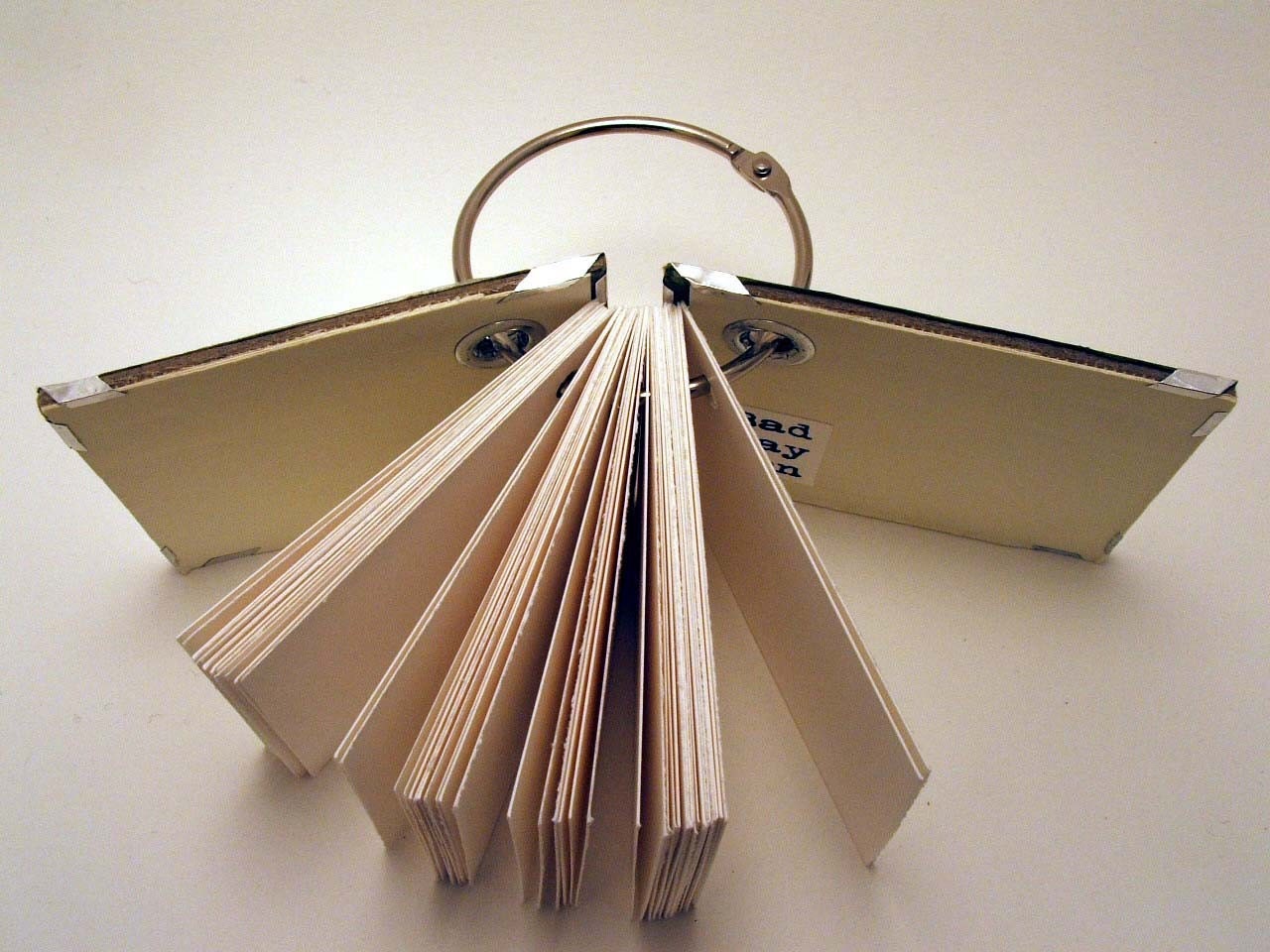
You can buy a fairly small key-chain with cue
cards that will not clutter your
handbag and will even fit into
a pocket
Any research project in my area begins with a lot of reading. First, you read or re-read your primary sources. In my case, the primary sources are often lengthy Realist novels. Then, I think about the reading for a while, write down several ideas, and turn to secondary sources to see what people who have researched this work before me had to say about it. 

While I read, I always stop whenever I encounter a passage that interests me and sounds like it might be useful and copy it on a cue card. Copying sounds like extra work, but I have discovered that while I'm copying a quote, I begin to think really hard about it. Many important insights often come to me while I do it.

Everywhere I go, I carry two key-chains with me. One contains quotes from my primary sources. The other one, has quotes from secondary sources. In this way, my research is always with me. While I'm on the bus, or stuck waiting in a line, or have several minutes with nothing else to do, I take out my cue cards and re-read them. I did that, for example, when I was writing my doctoral dissertation that had over 300 sources. As a result, I knew my sources so well that I could find any quote I needed in matter of seconds. 

The cue cards on the key chain can also be rearranged in any order which helps with structuring the piece I'm writing. I save all of these key chains because you never know what source you might need to consult in the future. Recently, for example, I needed some sources on the narrative nature of identity. Instead of doing this research all over again, I just disinterred my stacks of cue cards from 5 years ago when I was working on this topic. Within half an hour, I got everything I needed from these old cue cards and was ready to proceed with writing.

I'm not insisting that this system will work for everybody, of course. I, however, find that it really simplifies things for me. Feel free to share any useful tricks you have come up with to organize your research.